Home / Project Overview

A campus for living and learning.

The Memory Health Life Center is a developing regional memory health initiative in Quitman, Texas. Its planned residential village for 54 people would sit on 29 acres adjacent to UT Health Quitman. This page walks through the mission, the site, the care model, the numbers, and the downloads behind it.

Our Mission

What we are here to do.

The Wood County Health Care Foundation began with one promise: build a place where families do not have to leave East Texas to find good dementia care, and where the people who provide that care can learn how to do it well.

The foundation's mission is to do what is right for our community, our state, and our country by developing an all-inclusive center for individuals challenged with Alzheimer's disease based on their ability to pay, and to assist in the advanced education of healthcare professionals and service providers in a safe environment for residents and visiting family members.
Wood County Health Care Foundation · 501(c)(3) · EIN 75-2309177

The Need

Why East Texas, and why now.

Alzheimer's disease and related dementias are becoming more common as Texas ages, and rural communities feel that shift first. In much of East Texas, the specialized care, caregiver support, and trained workforce that families need are far from home.

459,300

Texans age 65 and older living with Alzheimer's disease.

Source · Alzheimer's Association, 2024

Specialized care is far away.

Outside the major metro areas, families often choose between local settings not designed for memory loss and long drives to urban specialists.

Caregivers carry the weight.

Spouses and adult children often provide years of care at home with little training, relief, or professional support.

The workforce is thin.

Dementia-trained nurses, social workers, and physicians are in short supply in rural East Texas, with few places nearby to learn the work.

"This town could be a community, an Alzheimer's-friendly community, where the restaurants and everybody in town would understand how Alzheimer's works."
Debbie Robinson, President, Wood County Health Care Foundation

The Larger Purpose

One Center. A broader vision.

The Memory Health Life Center is envisioned as more than a place to live. It is an opportunity to strengthen how East Texas understands, supports, and responds to dementia, bringing residential care, family resources, professional education, and community involvement into one coordinated effort.

  1. 01● Planned

    Residential Community

    A different approach to daily life for people living with dementia.

  2. 02● Underway

    Families & Caregivers

    Helping families navigate dementia through knowledge, resources, and support.

  3. 03● Planned

    Education & Workforce

    Developing opportunities to prepare and strengthen the dementia-care workforce.

  4. 04● Exploring

    Healthcare & Clinical Resources

    Exploring opportunities for healthcare collaboration and professional consultation.

  5. 05● Underway

    Community Engagement

    Building greater understanding of dementia across East Texas.

  6. 06● Exploring

    Learning & Future Impact

    Creating opportunities to learn from the model and potentially share successful approaches beyond Wood County.

Underway is offered through the Foundation today · Planned is in the project plan, not yet operating · Exploring is a possibility under consideration.

Education & workforce

A living-learning setting.

A planned education and training center would let care professionals and family caregivers learn the care approach firsthand, beside the homes where it is practiced. Healthcare collaboration and clinical learning are being explored, and the Foundation hopes to share what works with other communities.

Planned. Programs will be defined as the Center is designed.

Partners across the region

Built with the community.

The 29-acre site is owned by the Wood County Central Hospital District and sits directly adjacent to UT Health Quitman. Cities, civic clubs, health organizations, and elected officials across the region have written in support of the project.

Read the letters of support · Talk with us about partnering

The Site & Region

29 acres, next door to a hospital.

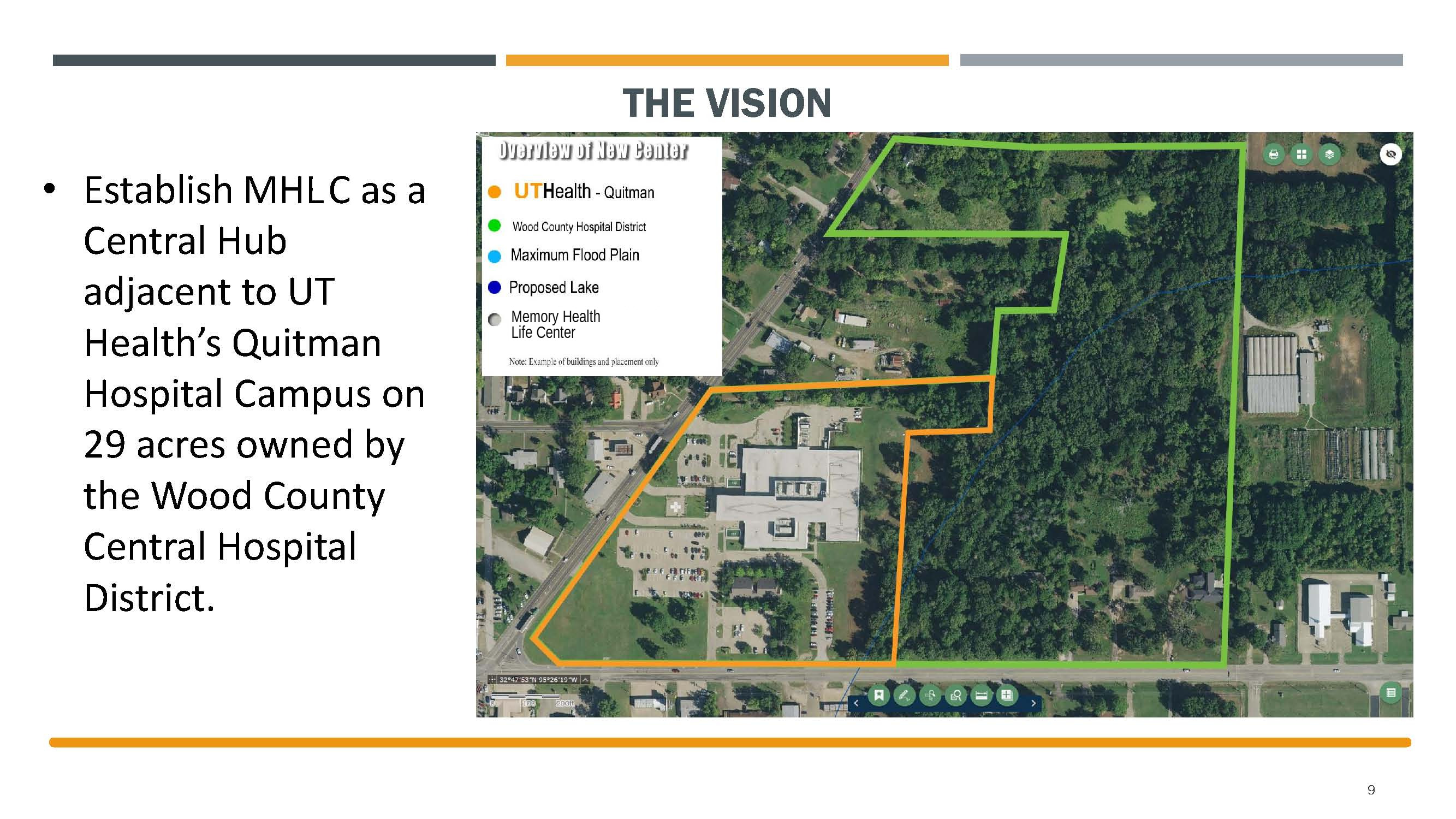
The Memory Health Life Center site is 29 acres owned by the Wood County Central Hospital District, directly adjacent to UT Health's Quitman Hospital campus. The siting is intentional — next to a hospital, and a regional position that puts millions of Texans within reach.

The site

Adjacent to UT Health Quitman.

  • 29 acres owned by the Wood County Central Hospital District
  • Direct adjacency to UT Health's Quitman Hospital — clinical support a walk away
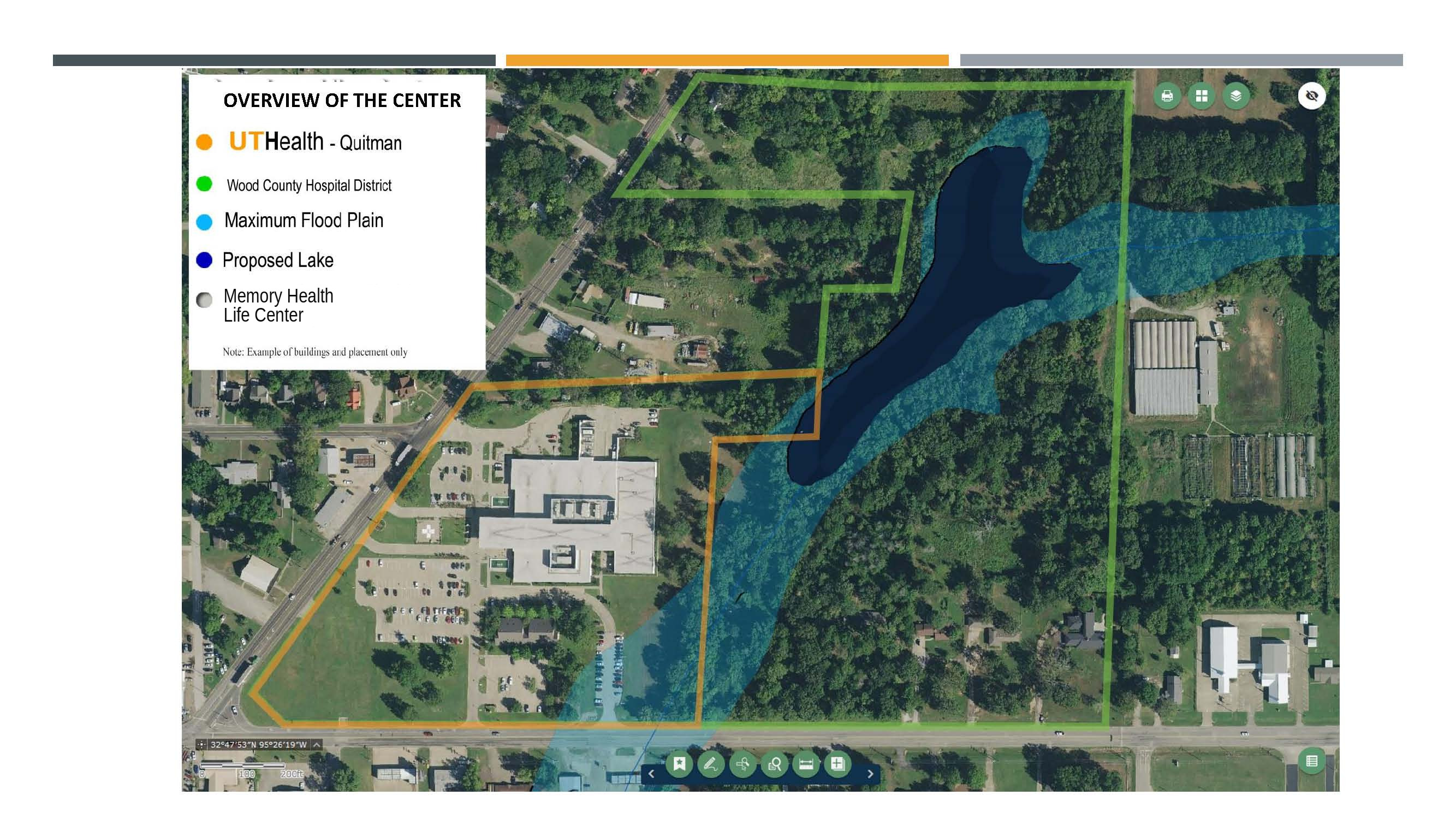
  • Reflection lake, walking paths, gardens integrated into the site plan
  • Pet-friendly grounds with gardens and a greenhouse, plus a barn with stables for horses and tame animals

A regional hub

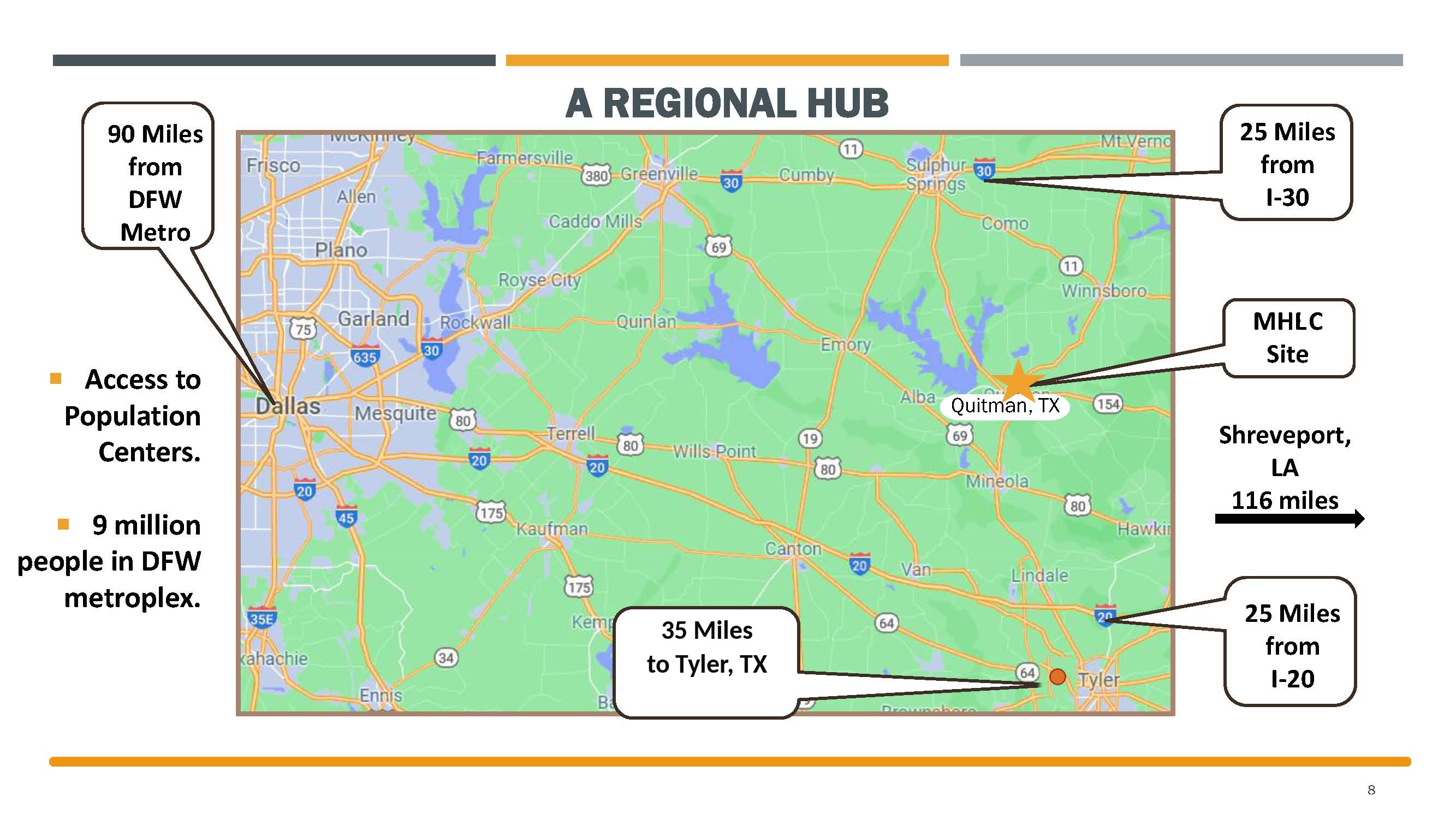
From Quitman to the rest of East Texas — and beyond.

From DFW Metro
90 mi
From I-30
25 mi
From I-20
25 mi
From Shreveport, LA
116 mi

9 million people live in the DFW metroplex alone, all within a 90-mile reach of the campus.

The Plans on Paper

Zoom in from the region to the lake.

Three views of the same project: where Quitman sits in East Texas, the 29-acre footprint adjacent to UT Health Quitman, and the overlay showing the proposed lake and hospital-district boundary on the site itself.

Regional Hub map showing Quitman, Texas relative to DFW Metro (90 mi), I-30 (25 mi), I-20 (25 mi), and Shreveport (116 mi)

1 · Regional

A regional hub for East Texas.

Quitman within reach of DFW, the I-30 and I-20 corridors, and Shreveport — millions of Texans inside a 90-mile orbit.

Aerial map of the 29-acre Memory Health Life Center site, outlined adjacent to the UT Health Quitman Hospital campus

2 · The Vision

29 acres, next door to the hospital.

The Memory Health Life Center site is 29 acres owned by the Wood County Central Hospital District, directly adjacent to UT Health's Quitman Hospital campus.

Detailed site overview showing the UT Health Quitman footprint, Wood County Hospital District boundary, maximum flood plain, proposed lake, and Memory Health Life Center site

3 · Site Detail

Lake, flood plain, and footprint.

The site overview with the hospital-district boundary, the maximum flood plain, the proposed reflection lake, and the placement of the Memory Health Life Center grounds.

Click any map to view at full size. For the full concept deck with renderings, see Downloads.

What's on the Campus

Six places, one campus.

Not a single building with corridors and doors. A village — residential homes, gardens and a greenhouse, an education and training center, a barn, neighborhood spaces, and reflection grounds — designed so daily life feels like a neighborhood, not an institution.

Resident Homes

Small homes, each shared by 8 to 12 residents. The village is planned for 54 residents in all. Each home has an open floor plan and large windows. No long, cold hallways lined with doors. Wall colors, paintings, and sculpture along common areas. Every aspect of design is tailored to those with memory issues.

Gardens & Greenhouse

Gardens and a greenhouse where residents can grow flowers and vegetables, work with their hands, and connect with nature as a regular part of the week.

Education & Training

A planned center for education and training, intended for care professionals and family caregivers. Healthcare collaboration is being explored, and the Foundation hopes to learn from the model and share what works with other communities.

Reflection Lake & Paths

A reflection lake with groomed walking paths, full of trees, green grass, and wildflowers. The healing power of outdoor spaces is the centerpiece of the campus, not an afterthought tucked behind the buildings.

Barn & Animals

A barn with stables for horses and tame animals, reached by its own footpath from the homes. Residents and their guests can pet the animals and spend time with them. The barn is a place to take part, not a backdrop.

Neighborhood Spaces

Everyday spaces at the scale of a home and a neighborhood: shared meals around a table, a porch in the afternoon, and gathering places the whole village can use. They are built around routines residents already know, not a dining hall and activity schedule for a whole building.

The Care Model

Hogeweyk-inspired. Zeisel-trained.

The care model was pioneered by John Zeisel, PhD — a leading expert on dementia care and a former Harvard professor — and built on five foundational principles. The same five principles shape every program, every space, and every interaction on the campus.

  1. 1

    Community Design

    Warmth and security, built in.

    Homes rather than wards: familiar rooms, art and color along the walkways, natural light, and safe ways outdoors — so residents can move about freely and still feel secure.

  2. 2

    Communication

    Skills to truly connect.

    Staff and families are trained in how to reach a person living with dementia — how to listen and how to respond — so every interaction builds trust rather than confusion.

  3. 3

    Engagement

    A reason to get up each day.

    Residents are connected with one another, with family and staff, and with the ordinary activities of a day — a shared meal, time in the garden, a visit to the barn. Purpose, not distraction.

  4. 4

    Creative Arts

    Ways to express what words cannot.

    Music, painting, theater, and movement help residents express themselves — pathways that often stay open even as memory fades.

  5. 5

    Nature

    Nature to nurture and soothe.

    Sunshine, gardens, walking paths, trees, water features, and animals are part of everyday life on the campus — not an occasional outing.

A neighborhood, not a hallway.

  • UsuallyA single building of corridors and doors.

    In QuitmanSmall homes shared by 8 to 12 residents, with open plans and large windows.

  • UsuallyA day organized around the schedule of the floor.

    In QuitmanRoutines a resident already knows: meals, walks, work in the garden.

  • UsuallyOutdoor space tucked behind the building.

    In QuitmanA reflection lake, paths, and gardens at the center of the site.

  • UsuallyActivity offered as a distraction.

    In QuitmanPurposeful daily life: a garden to tend, a barn to visit, neighbors to sit with.

This compares two design patterns, not the people who provide dementia care today.

How it differs

Living — and living well — with dementia.

Many memory-care settings focus on keeping residents safe and comfortable. Here, care is organized around interaction and engagement, so residents can enter a rewarding new phase of life.

A day, not a schedule

Care that follows the person.

Inspired by the Hogeweyk dementia village in the Netherlands, residents live in small homes and keep the routines they already know — meals together, a walk on the paths, time in the garden or a visit to the barn — with staff supporting them along the way.

A living-learning laboratory

Where caregivers learn the approach.

Planned education and training opportunities would let care professionals and family caregivers learn this approach firsthand, and the Foundation hopes to learn from the model and share what works with other communities.

The foundation reviewed dementia-village programs in the United States and in Sweden, Norway, Ireland, and England before settling on this combination — a hybrid that brings the Hogeweyk lineage to East Texas and adds a planned focus on education and training.

This describes the planned approach. Staffing and programs will be finalized as the Center is designed.

Project Progress

Where the project stands.

The Memory Health Life Center is advancing through a staged development process, and it is not yet open. Construction has not begun, and an opening date and construction schedule have not been set. The Foundation is the point of contact for current plans.

Completed
The vision and care model, the site, initial community gifts, federal funding for the clinic and education wing, and concept-stage site plans and renderings.
Happening now
The Foundation is beginning to engage an architect through a Request for Qualifications for architectural services, and is building relationships with early supporters and potential partners.
Still to be determined
The final design and construction budget, the operating model, financing, any formal campaign goal, and the construction and opening schedule.
Next
Architect selection, program planning, then design development and a financial feasibility review.

Receive project updates · Events & briefings

Independent reporting: The Texas Tribune, June 2024

  1. Stage 1 · Completed

    Vision, leadership, and initial support

    Planning began in 2020. A care model and a 29-acre site beside UT Health Quitman, initial philanthropic gifts, and federal funding designated for the clinic and education wing.

  2. Stage 2 · Underway

    Architectural selection and program planning

    The Foundation is beginning the process of engaging an architect to design the campus and refine the Center's programs. Request for Qualifications: Architectural Services (release date November 4, 2026).

  3. Stage 3 · Ahead

    Design development and financial feasibility

    Turning the concept into a design, with a construction budget and an operating plan to match.

  4. Stage 4 · Ahead

    Leadership philanthropy and capital financing

    Significant commitments and financing for construction. Any public capital campaign would be approved by the Foundation's Board.

  5. Stage 5 · Ahead

    Construction and opening

    Not yet scheduled. Dates will be shared once they are set.

By the Numbers

What it takes to build it.

Estimated project cost

~$60M

A preliminary estimate for construction, land development, and equipping the campus. Architectural planning will refine it; it is not a campaign goal.

Projected operating budget

$6.5M

A preliminary annual projection once the campus is open, to be revisited in feasibility planning.

Planned residents

54

Living in small homes of 8 to 12 residents each, sliding-scale fees.

Campus footprint

29 ac

Adjacent to UT Health Quitman, owned by WCCHD.

Federal funding · designated

$6,000,000

U.S. House Agriculture Subcommittee, FY appropriations. Designated for the clinic and education wing; not general or unrestricted funds.

Community gifts to date

$463,905

Gifts received, per the Foundation's gift records as of October 2026. See the honor roll →

Downloads

Take the deck with you.

For donors, board members, partners, and journalists who need the full picture — the foundation maintains a current presentation deck and the most recent conceptual drawings of the campus.

Both files open in a new tab. Need a different format? Contact the foundation.

A vision taking shape

Be part of it from the beginning.

As architectural planning begins, individuals, families, foundations, businesses, and community partners can each help turn this vision for memory health into a lasting resource for East Texas.